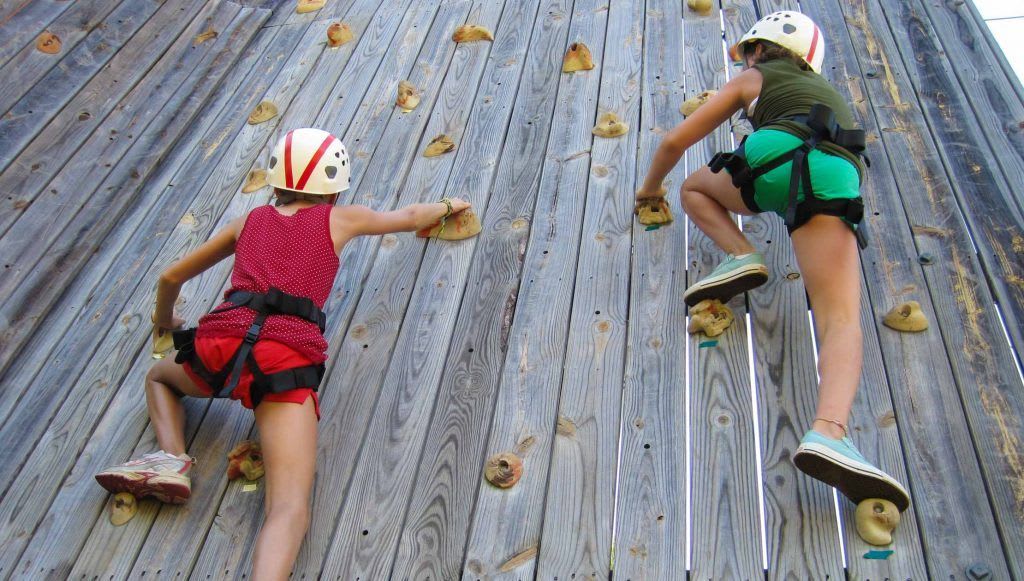

Lake of the Woods
Michigan, United States
- Gender
- All girls
- Stay
- Overnight camp
- Ages
- 7 - 15 yrs
- Staff to camper
Field Guide
Summer camp in Michigan
A field guide to what a camp summer looks like in Michigan: the forms it takes, how the landscape and climate shape it, and what it asks of a family.
Field notes
Weather in Michigan
Summer here is warm but genuinely short, strongest from the end of the school year through late August. The southern part of the state, where the representative station sits, runs warm and often humid, with afternoon thunderstorms that can clear a waterfront in a hurry. North and along the open lakes the season softens into cooler nights and lake breezes. The water is the thing to understand: inland lakes warm up for real swimming by midsummer, but the open Great Lakes stay cold and bracing even at the peak, so a shoreline swim can be short and shock-cold. The figures below are air temperatures from the state's representative station; they run cooler as you go north and near the big water.
camp season (June-August (representative core camp season)) runs highs of 80-84°F (27-29°C) and lows of 60-64°F (16-18°C).
Getting there in Michigan
Most families fly into Detroit Metropolitan Wayne County Airport (DTW), by a wide margin the state's busiest gateway. For camp country itself, smaller hubs often make more sense: Gerald R. Ford International Airport (GRR) at Grand Rapids for the west side, and Cherry Capital Airport (TVC) at Traverse City for the northwest belt of lakes and arts campuses, which sits a long way from Detroit.
From the south, reaching a resident camp usually means an interstate run north, then a shift onto state and county roads, and finally a lake road for the last stretch; the far Upper Peninsula, across the Mackinac Bridge, is genuinely remote and better reached from a northern field or a long drive. Many day camps and the campus programs invert all of this, sitting right in the metro areas where families already live, so no travel is involved at all. Whatever the camp, treat transport and any pickup as something to confirm directly with it rather than to assume.
The Parent Side Quest in Michigan
Michigan asks very different things of a parent depending on the camp. Send a child to a northern lake or an arts campus and there is real distance in it: a drive of hours or a flight, a handoff at a dock or a dorm, and then a quiet stretch where the information loop narrows to whatever the camp chooses to share. Choose a metro day camp or a campus program and the distance nearly vanishes; the child is home by evening, or a short way down the road.
The visiting-parent scene up north is real but modest, and it mostly overlaps the lake-country tourism a family would find anyway rather than a hospitality world built around camp, which is worth knowing before picturing a summer of easy drop-in visits. Contact rules differ from camp to camp and are always worth confirming. The parent's own experience of all this, the waiting, the letters, the trust, is its own thing worth understanding; the [Parent Side Quest](/field-guide/parent-side-quest) is the part of the Field Guide about exactly that.
Disclaimer & Safety
General information:
This content is for informational purposes only and reflects market observations and publicly available sources. Kampspire is an independent platform and does not provide medical, legal, psychological, safety, travel, or professional advisory services.
Safety & oversight:
Camp programs operate within local health, safety, and child-care frameworks that vary by region. Because these standards are set and enforced locally, families should consult the camp directly and relevant local authorities for the most current information on safety practices and supervision.
Our role:
Kampspire does not verify, monitor, or evaluate compliance with these standards. Program details, pricing, policies, and availability are determined by individual providers and must be confirmed directly with them.