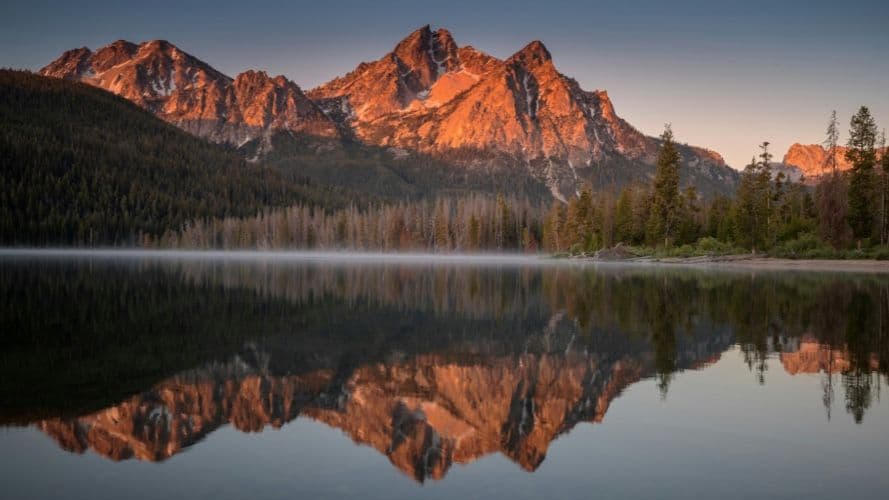
If you have watched the road narrow on the way up toward a mountain lake, the valley heat falling away behind you as ponderosa closes in on both sides, you already know something of the shape of camp in Idaho. Most of the state's overnight camps sit up where the water stays cold and the air cools off after dark, at the end of a highway that eventually turns to gravel. Getting there is part of what camp asks.
Idaho holds several kinds of summer for a child, though. The same state that runs a themed day camp in a Boise recreation center also puts teenagers onto a wilderness river for days at a stretch with no way to phone home. What follows is how those forms tend to differ, and what each of them quietly asks of a family.
Camp here sorts less by region than by kind. A handful of distinct forms have grown up alongside each other: resident camps on the northern and central lakes, expeditions that ride the rivers and cross the backcountry, youth camps held inside faith communities, and day camps in the valley towns where most families actually live. Only the expeditions are truly a product of the land. Idaho's free-flowing whitewater and its enormous stretches of roadless wilderness create a river-and-mountain journey that could not exist most other places; the rest are shaped more by who runs them and by where families already are.
Camps on the cold northern and central lakes
The overnight camps gather where there is cool water and forest to hold it. In the panhandle that means the glacial lakes and the timbered country along the Coeur d'Alene River; in the central mountains it means the lakes and reservoirs ringing the town of McCall, walled in by pine. A camp of this kind is a waterfront, a cluster of cabins, a dining hall, and a gate at the end of a mountain road. Days run to swimming in water that never really warms, canoeing and small boats, archery, hiking, and the long campfire evening; at the ranch-style camps the horses are the center of everything. Some are run by broad community organizations, some by independent nonprofits, and some by faith communities, and a number carry national camp accreditation.
For a family this is a real drive up out of the valley, a goodbye at a forest gate, and then a stretch of days with contact running only through the camp office. The distance is as much the point as the program is. A child comes back down the mountain having lived, for a little while, somewhere with colder water and darker skies than home.
When the road ends and the river begins
This is the camp Idaho's geography actually makes. The Salmon runs free and cold through granite canyon and through the largest roadless wilderness in the contiguous states, water fed by snowmelt and known for good reason as the River of No Return; the Selway and Bitterroot country lies north of it. Put a teenager here for several days and camp becomes something closer to an expedition.
The pattern is a multi-day trip by raft, by kayak, or on foot: learning to read moving water and set a paddle, to make and break a camp on a river beach or a high trail, to be responsible for the group and not only oneself. Some of these run as adventure camps a family can enrol a child into, including wilderness trips built for girls and the courses of national outdoor-education schools. Others are stewardship crews that pair backcountry travel with trail and restoration work; these tend to be application-based and drawn from young people already in Idaho and nearby, so they are less something you shop for than something a teenager earns a place on.
The consequence is unlike any drop-off at a gate. The handoff happens at a river put-in or a trailhead, and from there contact does not thin, it closes: no signal, no road, no call until the take-out days later. Families reach the deepest country by small aircraft to a backcountry airstrip, because nothing else reaches it. Sending a child into that asks a particular kind of trust, made once, at the water's edge.
Summers that belong to a community
Across much of Idaho, and most of all in the southeast, summer for a great many children is not something a family shops for at all. It is organized inside the community itself. Summer for children here tends to mean youth camps and girls' camps held through a congregation or a faith community, at a mountain property the community keeps or a site it borrows, run by volunteers and keyed to the community's own calendar. These serve the young people of that community rather than visiting families, and they come and go with the year rather than sitting open for enrolment. Described from the outside, the plainest thing to say is that the handoff here is usually to adults the family already knows, and camp is part of what the community does together through the summer.
Down in the valley, where camp comes home at night
Where most Idahoans actually spend the summer, camp looks nothing like a mountain drive. In the Treasure Valley around the capital, across the Magic Valley, and around Idaho Falls, the common form is the day camp: weekly and themed, run out of recreation centers, city parks, museums, and university classrooms by parks departments, community organizations, and youth clubs. A week might be sports, or art, or science, or time spent outdoors, and the child is home again by evening. Registration tends to open in spring and the good weeks fill fast.
The trade is the inverse of the wilderness trip: no distance to cross and no stranger to trust in the mountains, only a camp that folds neatly into the working week and hands the child back each night.
The weather a camp day turns on depends on where in the state you stand. The southwest, around the capital, runs hot and dry through high summer with a wide swing from a strong afternoon to a genuinely cool night; the north and the higher mountains stay cooler and greener. What the whole state shares is cold water. Lakes and reservoirs warm slowly and never much, so swimming tends to be bracing and brief, and the rivers, born of snowmelt, run high and cold early in the season before dropping as it goes on. Afternoon thunderstorms build over the peaks. The real wildcard comes late in summer, when wildfire smoke can settle into the valleys and canyons and quietly reshape a day outdoors. Daylight, at least, runs long.
What the parent experience feels like here runs the whole range. At a lakeside resident camp it is a drive up out of the valley, a goodbye at a forest gate, and a week of news filtered through the camp office. At a wilderness expedition it is more absolute: at the put-in your contact simply ends until take-out, and the waiting becomes the whole job. The mountain town of McCall gives Payette Lake families somewhere to linger, though it is a resort community serving all comers rather than a camp-parents' town as such, and places like Coeur d'Alene and Stanley play that general gateway role elsewhere. For the community-run youth camps the family is usually part of the same community, so the handoff is to familiar hands and the norms are locally understood. And for the valley day camps there is no waiting town at all, because the child is simply home by dinner. Both ends are true of the same state at the same time.
The thread running through all of it is that Idaho keeps its camps close to the land and close to the people who run them. Whether the water is a swimming lake or a rapid, whether the handoff is at a forest gate or a river's edge or the door of a community you already belong to, the state tends to ask a family for a clear-eyed sense of distance and trust rather than for polish. Knowing which kind of summer you are actually choosing is most of the work.
If you are earlier in all of this than you would like to be, the guide for parents is a place to find your footing before weighing any particular kind of camp. And if you find yourself wondering what a camp is really for beneath its activities, the broad shapes that camps tend to fall into are worth understanding in their own right; the camp archetypes is the part of the Field Guide about exactly that. In a state whose camps run from a neighborhood day program to a week off the grid on a wild river, those shapes map only loosely, which is itself worth knowing before you begin.