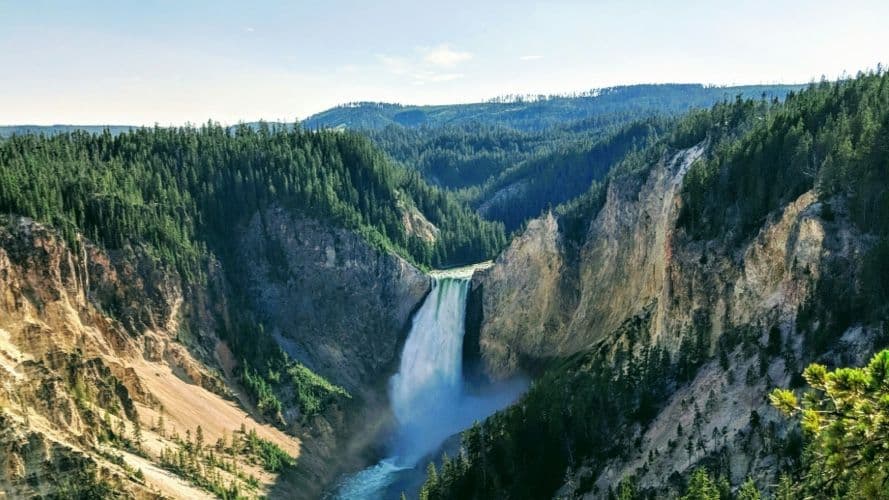
In this state the summer arrives late and leaves early. Snow can still be sitting on the high passes when the valleys have gone green, and a warm afternoon has a way of turning into a jacket-and-hat evening the moment the sun drops behind a ridge. Parents here already know the shape of it: a short, bright, windy season squeezed between long winters, with the mountains close enough to change the weather in an hour.
Camp fits into that narrow window, and it does not look the same everywhere. In the ranch country and the roadless ranges it can mean a horse of your own and a pack string headed into the backcountry. In the resort valleys it can mean a morning drop-off and an evening pickup a short drive from the kitchen table. In the mountain towns and out on the plains it can mean cabins and pines within reach of home. This is a read on those forms, and on what each of them quietly asks of a family.
What separates one camp from another here is less the county line than the kind of thing it is. And in a state this rugged, some of those kinds exist because of the ground itself. The working ranch and the roadless range are not backdrop; they are the reason a certain camp exists at all, the sort that hands a child a horse and a string of chores and then walks them up a trail until the road is long gone behind them. Other forms lean on the land more lightly. What follows tracks the forms, and lets the country explain them where it genuinely does.
Horses, chores, and the country past the trailhead
The old heart of camp in this state puts a child on a horse and keeps them there. On working ranches along the edge of the greater Yellowstone country, in the Dubois and Wind River valleys and up against the Absaroka front, the overnight camp is built around horsemanship: a camper is often paired with a horse of their own and learns to saddle it, ride it, and care for it before anything else. The days carry real ranch work, and the sessions run long.
From that base the camp travels. Horse pack trips and backpacking routes climb out of the valley and into the ranges, and at the more expedition-minded end of the same tradition the trip becomes the whole point, a run of days moving on foot through the Wind River or the Bighorns with everything carried along. Skills here are earned rather than sampled. The country does the teaching, and it does not hurry.
For a family this is the genuine article: a long session, a setting hours up secondary and gravel roads, and days when a backcountry trip is out of contact and no news is the expected kind. The handoff asks for a certain trust in the quiet. If a child comes home changed by a summer, this is the form most likely to do it, and the way skill and place work on a young person over time is one of the things the camp archetypes try to name.
Day camp where the family already is
Around the resort and gateway valleys, camp turns into something a child comes home from each evening. In the Teton corridor especially, the day camp is common and varied: field science and wildlife study, hikes and canoe trips and paddling, biking, and the kind of creative and challenge-course days that fill a summer for a broad span of ages, from the very young on up. At the older end a few short field-research trips slip overnight into the parks, but the center of gravity is the day itself.
The consequence here inverts the usual one. Many of the families these camps serve already live in the valley or are staying nearby, so the hard part of camp in most places, the getting there and the letting go, mostly falls away. The child is back at the table by supper. What a parent trades for that closeness is the long, slow arc of a resident summer; what they keep is the mountains out the window and a short drive between them and the day.
A week on the mountain, close to home
Out on the plains and in the mountain towns, the steadiest form of camp is the civic one. On Casper Mountain, in the pines of the Bighorns, at county fairgrounds and extension grounds and state outdoor-education sites, the summer runs on cabin camps and day programs that have been part of these towns for generations. Some are run as community and service-club camps, some by county programs and extension clubs, some by long-standing Christian mountain and church camps, and some by the state's own conservation and outdoor-skills educators. The faith-based camps are simply part of that fabric, described here as what they are and nothing more.
This is camp as a local institution rather than a journey. The counselors are often familiar, the families frequently know one another, and the drive is short enough that the mountain can feel like an extension of town. What it asks of a parent is small and old-fashioned: a stretch of days handed to a place the community has trusted for a long time, and a pickup at the end of it.
On the Wind River, summer on the land
At the center of the state lies the Wind River Reservation, home to the Eastern Shoshone and the Northern Arapaho, where summer for children carries a meaning of its own. Here it tends to mean time on the land itself: water and wildlife, conservation and stewardship, language and story, and cultural knowledge passed along by community members and elders, often gathered into short days rather than long sessions. From the outside only the shape of this is visible, and it is set down here with that limit kept in view.
What can be said plainly is that this is community-rooted and community-serving. It is woven into the life of the reservation and given to its own young people, not offered as something a visiting family signs up for. A frame of dropping a child off and sending them away does not fit here, and this account keeps its distance accordingly.
The weather is the first thing a camp day here answers to. Summer runs warm and dry by afternoon and turns cold at night, and the higher the camp sits, the sharper that swing, so a hot ride can end in a hunt for a fleece. The season is genuinely short, with snow lingering on the passes into the early weeks and the backcountry staying cold long after the valleys warm. Thunderstorms build fast over the peaks in the afternoons, and lightning on an open ridge is treated as the serious thing it is. Wind is close to constant, the sun is strong at altitude, and the rivers and alpine lakes run snowmelt-cold, so swimming tends to be bracing and brief rather than a lazy-lake affair. Late in the season, smoke can drift in from distant fire. The daylight, at least, runs long and generous through the heart of it.
The distance between a parent and a camp runs the whole range in this state. At one end sits the multi-week ranch or expedition camp, a real separation of hours of secondary and ranch road, thin cell service, and a loop of news that goes quiet by design. At the other sits the valley day camp, where a parent may be in the same town the whole time and the child is home by dark. The gateway towns do have places to stay and eat, but that is Yellowstone and Teton tourist country, not a waiting-culture built around camp families; across much of the rest of the state there is no waiting town at all, and families drop and drive home. Wherever a given family lands on that range, the experience of being the parent through it is its own thing worth understanding, and the Parent Side Quest is the part of the Field Guide devoted to exactly that.
What ties these very different summers together is the country they happen in: high, wide, thinly peopled, and honest about its own weather. Whether a child ends up on a horse in the backcountry, at a science bench a short drive from home, in a cabin the town has trusted for generations, or on the land with their own community, the state asks the same thing underneath. It asks a family to work with a short, bright, unpredictable season instead of against it, and to accept that the mountains keep their own schedule. The camp that fits is the one whose shape matches the summer a family actually has.
None of this settles the practical questions that come before a deposit: what to ask a camp, how to read a program, how to tell a real fit from a merely nearby one. Those belong to every camp family everywhere, not to this state alone, and the guide for parents is where the Field Guide works through them. Start there for the how, and come back here for the shape of what summer camp tends to be in this high and windy place.