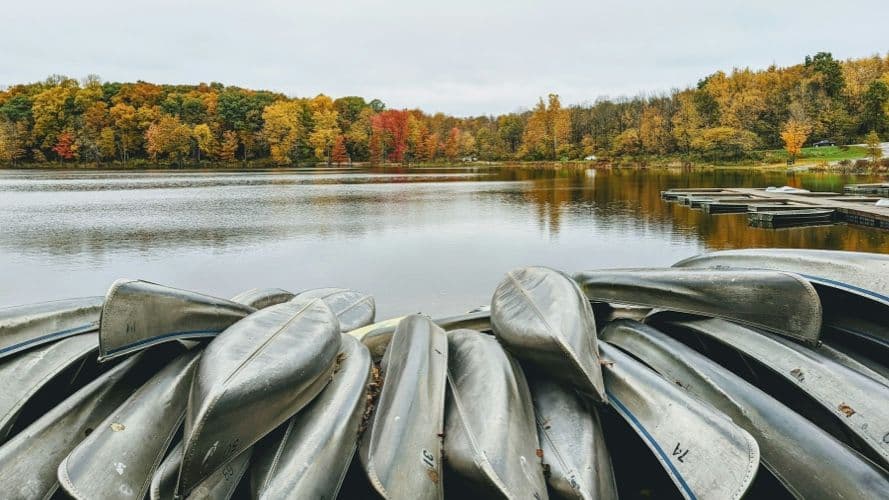
In Indiana, summer has a shape you can almost set your watch by. School lets out, the corn comes up past knee height, and somewhere between the last day of classes and the week of the county fair, a duffel bag goes in the back of the car. For a lot of Hoosier families, camp fits neatly into that window, close enough to home that it feels less like an expedition and more like a season everyone already knows the rhythm of.
The drive tells you which kind of summer you picked. Head north and the land flattens, then fills with small glacial lakes, and the camps sit right on the water. Head south, past the capital, and the ground buckles into wooded hills where camps disappear into the trees. In between, in the cities, a different kind of camp opens its doors each morning and sends everyone home again by supper.
Camp here sorts less by where it sits than by who built it and what a week there is for. The same lakeshore or wooded hill can hold a waterfront skills camp, a church's summer program, or a county's cooperative week, and the difference a family actually feels is in the purpose, not the postcode. So the forms below are grouped by what kind of camp they are, with the landscape treated as the backdrop it usually is rather than the thing that decides.
A week on the water, a week in the woods
The oldest and most familiar shape of camp here is the resident week. A child packs a bag, moves into a cabin with a whole group of others, and doesn't come home until the session ends. Up north these camps ring the small lakes and line the slow rivers, and the day bends around the waterfront, swim tests, canoes, kayaks, the long walk down to the dock. Down south they tuck into the wooded hills and trade the lake for trails, a climbing tower, archery, and a barn of horses.
What this asks of a family is the classic handoff: a real goodbye at a gravel lot, a stretch of days trusting other adults on a shoreline you have only seen at drop-off, and a child who comes back a little more their own person. Sessions tend to run by the week, and many camps hold a visiting day or a closing program, though exactly what is on offer any given summer is worth confirming with the camp itself.
When the week is built around faith
A large share of Indiana's camps are run by churches, and here that is a plain feature of the landscape rather than a niche corner of it. Some belong to a single denomination and gather children from its congregations; others are independent and draw from many churches at once. From the outside, a week at one of these can look much like any other resident camp, the same lake, the same cabins, the same archery range down the hill.
What sets the week apart is that faith sits at the center of the daily rhythm, chapel and songs and quiet time folded in beside the swimming and the crafts. Families who share the tradition often know the camp through their own congregation long before a child is old enough to go, and the counselors may be familiar faces.
For a family inside that world, the handoff carries less distance than the miles suggest, because the people on the other end are part of a community already known. For a family outside it, these camps are worth understanding on their own terms rather than by the activities list alone, and the welcome and the expectations are best learned directly from the camp.
The camp the county runs
Threaded through nearly every county is a cooperative kind of camp, grown out of the farm and home clubs that have met here for generations and organized through the state's agricultural extension. Children who spend the year in local clubs come together for a short stretch of nights at a shared camp, often the very grounds their parents and grandparents used, for cooperative living, hiking, crafts, sports, and the ordinary work of getting along in a group. It leans civic and communal rather than specialized, older teens frequently come back to serve as counselors, and the whole thing feels less like a program a family shops for than a rung on a ladder the county keeps.
In town, home by dark
In the cities, camp inverts. Instead of the family driving out to the camp, the camp is already where the family is: a downtown museum, the zoo, a science center, a parks gym, a college campus for a week of robotics or theater. Children arrive in the morning and leave in the afternoon, and the whole thing runs on the rhythm of a working parent's day.
This is the low-friction end of the summer. There is no packing, no long goodbye, no shoreline you cannot see; there is a pickup line and a child full of whatever they made or discovered that day. What it asks is mostly logistical, the summer-long puzzle of stitching weeks together, and it is the version of camp most Indiana families already know.
Indiana summers run warm and humid, the kind of heat that settles on the skin by midafternoon and pulls thunderstorms up out of a clear sky, quick and loud and gone. The lakes and rivers warm enough for real swimming by the heart of the season, though nothing here is tropical and the water keeps an edge to it early on, with the big lake along the northern rim staying cooler and quick to turn windy. Mornings can start cool, the bugs near the water are honest, and the green season itself is generous, a long stretch from late spring to the end of summer break.
Distance is rarely the obstacle in Indiana that it is in bigger, emptier states; most camps sit within a few hours of home, and for many families camp is a drive rather than a flight. That closeness shapes the handoff. Resident camps hold families at arm's length by design and communicate on their own terms, so the information loop is worth asking about before a session rather than during it. Some camps sit near towns built for visitors, the artists' village down in the southern hills, the lake-resort towns up north, where a family can turn drop-off into a weekend, though that is the town's doing and not anything the camp arranges. Day camps ask none of this; the child is home by dinner and the loop closes itself every evening.
What runs under all of it is a state that treats camp as ordinary and close at hand rather than exotic or far away. Whether a week means a cabin on a lake, a chapel in the woods, a county's shared grounds, or a museum downtown, the common thread is a summer built to be reachable and held together by people who tend to already know each other. That familiarity is the Indiana texture of camp. It helps to understand the underlying shapes camp can take before matching one to your child, which is what the camp archetypes are there to make clear.
If you are working out what any of this asks of you rather than of your child, the wider guide for parents is the place to start. It is less about Indiana in particular than about the questions every camp family ends up walking through, wherever the cabin or the classroom happens to be.