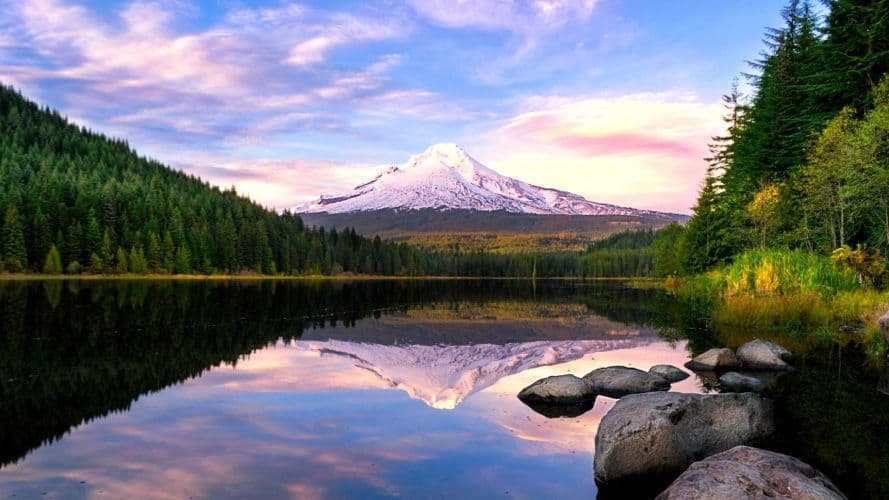
Ask what summer looks like in Oregon and the honest answer is that it depends where you stand. In July a child on the coast can be zipping a fleece against the fog while, a morning's drive east over the mountains, another is squinting into dry high-desert sun, and back in the Cascade foothills someone else is climbing out of a snowmelt-cold lake. Parents here learn early that the question is not whether there is camp, but which Oregon the camp lives in.
That spread is the whole story. What camp asks of your family in this state depends almost entirely on which landscape it sits in, and those landscapes are genuinely different animals.
Camp in Oregon sorts by form, and the forms follow the land because the land makes them. The cold ocean turns coast programs toward skill and science rather than swimming. The wet, timbered slopes of the Cascades and the Mount Hood country hold the old resident-camp shape, cabins and tents and a lake. The high desert and the valley towns, where most families actually live, run day camps that fold into an ordinary week. And moving quietly alongside all of it, a different kind of summer, held close to the land and to community, shapes the season for many Native young people. Reading camp here means reading the map first.
A week in the timber
The oldest shape of camp in Oregon is a week in the woods. Back in the foothills of the Cascades and along the Mount Hood corridor, where the timber is thick and the lakes are clear and cold, families still hand a child over for a stretch of nights away from home. Some of these camps lean hard into wilderness skill, fire and shelter and tracking and paddling; others keep the gentler cabin-and-lake rhythm a parent might recognize from their own childhood.
Who runs these camps is part of what they are. Churches and denominational gatherings, cooperative and civic youth groups, and independent nonprofits all keep resident camps back in this country, and the character of a week shifts with the hands that hold it. A family choosing among them is really choosing a small culture to live inside for a while.
The consequence is the classic one. You drive to the end of a forest road, you hand your child over, and you go home to wait, with the mountains and the thin cell signal deciding how much you hear before pickup. It is the version of camp that asks a parent to let go most completely.
What the cold water asks for
On the coast, the water settles the question of what camp is for. The Pacific here is cold and rough the whole year through, so the programs that gather at the shore and the estuaries are not built around swimming. They are built around competence. Children work the tidepools and the bays beside the people who study them, or they learn to read the wind and handle a small boat on protected water, and the ocean stays something to understand and respect rather than splash in.
For a family, that reshapes the packing list, and the expectation with it. Send a child dressed for cold and wet even at the height of summer, and understand that the draw is a skill earned and a curiosity fed, not a warm afternoon on the sand. The children who take to it tend to come home talking like young scientists or young sailors.
Camp that never leaves town
The densest layer of camp in Oregon never involves leaving town at all. Around Bend and across the high desert, and through the valley cities where most families live, museums and nature centers and parks programs and civic youth groups run day camps that send children home every afternoon, full of horses or river science or high-desert ecology or an unfinished art project. There is no handoff to brace for and no far-off place to picture, because the camp is folded into the same week the family is already living. For a great many Oregon parents this is simply what summer is, closer to a daily adventure than to sending a child away.
Summer that stays on the land
There is also a kind of summer here that does not belong to any market. Within Native communities in Oregon, summer for young people is widely understood to include time spent on the land, learning cultural knowledge, language, and the science of place from community members and elders, sometimes at gatherings that keep young people overnight and sometimes closer to home. Sources describe these as recurring and rooted, often supported by universities and public agencies, and shaped by the communities themselves.
These gatherings tend to be selective or community-held, and they largely serve Native youth rather than being something an outside family arranges. Where this is the summer a child is part of, the family is usually near or inside the community that holds it, and a child is handed to people already known. It is worth naming plainly, and worth understanding from the outside as exactly that, a pattern of summer that belongs to the communities living it.
Plan for the Oregon a camp actually sits in, not for some fixed idea of summer. Once the wet season finally breaks, the valley and Portland turn warm and dependably dry by day, and cool enough at night that a foothill evening wants a jacket. The coast keeps its own weather entirely: fog, wind off the water, and a chill the afternoon sun may or may not burn through. The mountain lakes run snowmelt-cold, and Cascade nights drop fast. East of the mountains the high desert swings hard, hot and bright under a big sky by day and genuinely cold after dark. Daylight stretches long and late. The thing the whole state shares is late summer itself, when wildfire smoke can drift in and rearrange an outdoor day, and dryness makes fire-awareness part of ordinary camp life.
Because the forms are so different, so is the parent's experience of them. At the day camps that fill the towns there is barely any distance to cross: an afternoon pickup, an ordinary week, and no waiting town to sit in, since the family is already home. At the resident camps back in the timber the older ache returns, the drive in, the drop-off, and the quiet stretch of days when letters and whatever contact the camp allows are the whole of the information loop. The towns near those camps are just ordinary Oregon towns, not places built to hold waiting parents, so the waiting mostly happens at home. And in the land-based summers of Native communities, the family is often close to or inside the thing itself, and the handoff is to people already known.
What ties these very different summers together is that in Oregon the landscape is never only scenery. The cold of the water, the reach of the timber, the dryness of the desert, the nearness of home: each one decides what a camp can be and what it will ask of you. Choosing well here starts with being honest about which Oregon you are sending a child into, and what that particular ground tends to make of a summer.
If you are early in this and want the groundwork, the guide for parents walks through how to think about camp before the particulars of any one place. And because camp everywhere sorts into a few deep kinds whatever the local landscape, the idea of camp archetypes is a way to understand those underlying shapes, so you can recognize which one a given Oregon camp really is beneath its coast fog or its desert dust.