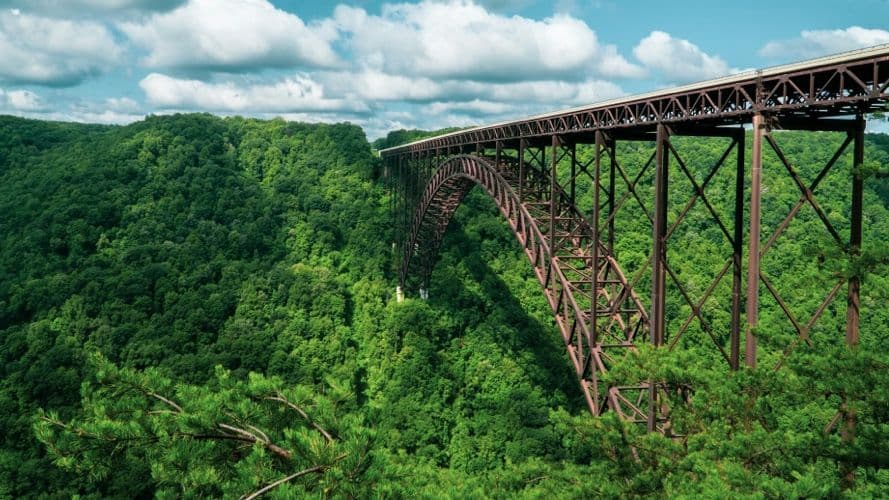
If you were raised here, you already know the drive. Off the interstate, onto a back road that starts to climb, past a filling station and a white church, then up a creek valley where the morning fog is still sitting low in the hollow. Camp in West Virginia tends to live at the far end of a road like that, folded into forest that closes in green on both sides.
It is a mountain state, and that shapes almost everything about a summer here: the cool nights at elevation, the rivers running fast and cold through the gorges, the way a camp can feel genuinely tucked away. But the thing worth knowing at the outset is that camp here comes in real, distinct kinds. It arrives through several different doors, and which door a family walks through says a great deal about what the summer will ask.
The clearest way to read camp in West Virginia is by who is running it and what kind of camp it is, rather than by which mountain it happens to sit on. The scenery stays close to constant: cool forested acreage, a creek or a lake, ridgelines on every side. What actually changes is the door. There is the camp that comes up through the county, the private sleepaway tradition in the high country, the faith camps tied to congregations, and the river-and-expedition programs that exist only because the water and the terrain here are the real thing. Terrain earns its place in that last kind, where it genuinely makes the camp what it is. Everywhere else it is the backdrop, not the reason.
Camp that comes up through the county
For a great many children here, the earliest experience of camp is the one that runs through the state's cooperative-extension service. It reaches into every county, and it has a rhythm to it: a child heads off with others from the same county, often to a nearby camp, sometimes to a larger state gathering held in the interior. Alongside the county camps sit statewide sessions built around conservation, the outdoors, and leadership.
The days lean practical and communal rather than boutique: cooperative cabin living, time on the water, shooting sports and fishing and cooking outdoors, the plain work of getting along in a group. For a West Virginia family this is often the most woven-in version of summer camp there is. The child is handed to a familiar local network rather than sent far, and the whole thing sits closer to a civic rhythm the state keeps for its own young people than to anything a family shops for. To see where a camp like this fits among the broader kinds, the camp archetypes are a useful frame.
The old sleepaway kind, up where the air cools
Higher up, toward the eastern ranges and the Alleghenies, sits the private overnight camp most people picture when they hear the word: wide forested acreage, cabins under hardwood canopy, a lake or a river bend, and a broad menu of days spent on the waterfront, on horseback, at the ropes course, in the arts barn.
Elevation does real work here. The nights cool off in a way the river valleys never quite manage, and the forest keeps the heat soft even at midday. Several of these camps have been running long enough to carry their own campfire traditions, their own songs, their own sense of a place a child comes back to across the years of childhood.
For a family, this is the clearest send-away decision on the page. It means a drive up into the high country and a genuine handoff for a stretch of days and nights, with the trade being an unplugged, tree-covered piece of summer that tends to lodge in a child's memory for a long time.
Where summer and faith share a calendar
A large and long-standing share of camp here is faith-based. Christian and Bible camps are scattered across the mountainsides and river bottoms, folding Bible study, worship, and devotional time into the ordinary furniture of camp: the waterfront, the ball field, the craft table, the evening around a fire. Some are tied closely to a particular denomination, some are broadly Christian, and the choice usually follows a family's own congregation and community. For families who want it, the summer becomes a place where recreation and faith formation happen in the same week, on the same ground.
Moving water, and what it asks
This is the strand of camp that the land itself makes. The New, the Gauley, and the Greenbrier are genuinely fast, cold, serious rivers, and the relief around them is real, so a distinct kind of youth programming has grown up out of it: teenagers learning to read and paddle whitewater, expedition and stewardship programs that walk children into the backcountry, environmental camps set right on a river, wildlife and nature study in the sanctuaries, and large-scale scouting adventure down in the southern gorge country. None of this is scenery borrowed for a brochure. It exists because the water and the terrain are the real thing.
It is worth being clear-eyed here. Much of what happens on these rivers is adult rafting tourism, which is a different world from a children's camp. And the genuine youth programs vary widely in how open they are, from broadly enrollable to selective or run for a particular community. The ask on a family is real too: moving water, remote ground, gear and instruction that matter. A family will want to confirm what a given program actually runs, and how word travels back out of country where a signal is never guaranteed.
Summer here is an Appalachian one: warm, humid days that soften noticeably after dark, especially at elevation, where the highlands and the hollows both give the heat back once the sun is down. Storms build over the mountains through the afternoon and evening. Mornings start with fog pooling in the low ground and along the rivers. The country is deep green and heavily wooded, which also means the biting insects are part of the day rather than an exception. And the rivers, fed straight off the mountains, run cool and quick even at the height of the season, so time in the water tends to be bracing rather than lazy. It is a long, usable summer, and it earns its green.
The parent's side of this splits along the same lines as the camps. For the private overnight, faith, and river programs, the shape is a drive up into the mountains, a real goodbye at the end of a climbing road, and an information loop that can genuinely go quiet, because gorges and hollows swallow a cell signal and contact norms are a thing to settle with the camp beforehand rather than assume. For the county extension camps, the handoff is short and familiar, a child heading off with neighbors to a place near home. Waiting nearby is possible in some places and not in others. The New River Gorge country around Fayetteville is a real tourism destination, so a parent with hours to fill has actual towns to fill them in, though that is the general visitor economy rather than anything built for camp families, and it is honest to call it that. Deeper in the highlands there is often no waiting town at all, and the plan is simply to drop and go.
What runs underneath all of it is the terrain. West Virginia does not really do the flat, sprawling kind of camp you could find just about anywhere. The land funnels children up creek valleys and onto forested ridges and down to fast water, and whichever door a family comes through, the summer ends up physical, close to the ground, and set somewhere that took a little effort to reach. Knowing which door you are walking through is most of the work, and you can do that part before you ever load the car.
If you are weighing what camp here would actually ask of your family, the guide for parents is a good place to think it through. And the parent's own experience of all this, the drive, the quiet, the handoff at the top of a mountain road, is its own thing worth understanding on its own terms. The Parent Side Quest is the part of the Field Guide about exactly that.